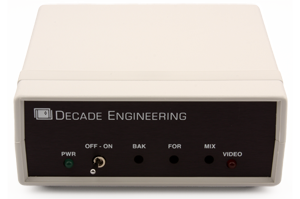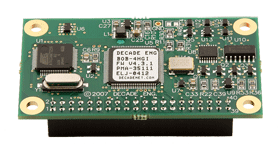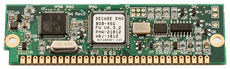
BOB-II is Decade's second-generation low-cost videotext overlay module. BOB-II lets your microcontroller or PC display up to 308 characters on standard video monitors and TV sets. BOB-II generates video on-board, or automatically genlocks to your video source and superimposes text on the image. Printable characters and commands control BOB-II through a fast RS-232 style data link, much like a simple serial printer. BOB-II is compatible with virtually all microcontroller chips and modules, including the BASIC Stamptm. Single units sell for $99.95 (NTSC or PAL), with a matching 30-pin socket and brownout detector IC.
END OF LIFE notice: For BOB-II design migration, please see BOB-4.
See also BNAB-GP, Decade's general purpose host adapter board for BOB-II.
![]()
![]()
Physical:
30-pin SIMM form factor, 3.50(L) x 1.05(W) x 0.35(H), weight is less than 0.5oz. BOB-II snaps into commonly available 30-pin SIMM sockets. A matching socket is supplied in the standard retail package.
Power Supply:
+8~16V nominal, 65mA typical current. Auxiliary +5V regulated output rated at 50mA and ±5% tolerance. Auxiliary supply output current adds to main supply current.
Data Path:
Asynchronous serial input at 2400, 4800, 9600, or 19.2Kbps, 8 data bits, no parity, 1 stop bit (8N1), inverted data, 5V logic levels. Connects directly to the UART transmit output pin of any 3~5V microcontroller. An inverting RS-232 interface is required for connection to a PC COM port (can use a single transistorsee BOB-II FAQ). Any standard terminal program (e.g. HyperTerminal) provides basic control of BOB-II directly from a PC keyboard.
Video I/O:
RS-170A (NTSC) composite, 1Vpp 75 Ohm unbalanced input and output. PAL video compatibility is optional at ordering time. The video output contains a small (+1V) DC bias, which is common to many video sources and well-tolerated at the inputs to most video equipment. Internal color video background signal is automatically generated if video input is not supplied. Composite sync output is provided.
Character Format:
12x18 pixel bitmaps. Up to 308 characters may be displayed, in 28 columns and 11 rows. 128 character patterns provided, including upper & lower case, European language support, and a set of graphics characters useful for bar graphs, etc. Non-ASCII characters are accessible through a simple command protocol. Default characters are displayed in white with a thin black outline, for best visibility against underlying image content.
Character Display Options:
Character color is supported in local video generation mode. Blinking may be selected for any character or group. Monochrome text (only) is available in genlock-overlay mode. External adjustment of transparency as well as character and screen brightness is optional. Entire text display may be toggled on/off without affecting contents of display RAM. Writes to display RAM are permitted while the display is off.
Notes:
Product specifications are subject to change without notice. Contact Decade Engineering to confirm current status if any specification is critical to your application.
BOB-II Pinout (PDF) Describes the function of every pin, but you have to connect only a few...
BOB-II Control Protocol (PDF) or, "How do I talk to this thing?"
BOB-II Character Set (PDF) Shows all 128 ROM character patterns.
BOB-II FAQ (PDF) Essential information for anyone developing a BOB-II application. Includes a short snip of MS QuickBASIC code for testing or demonstrating BOB-II with a PC.
BOB-II Application Examples
Vertical Bar Graph (PDF) A well-written example by Al Williams, using the Parallax BASIC Stamp II.
HyperTerminal configuration file example for BOB-II. Just double-click after downloading.
TV Typewriter (TXT) 68HC705 assembly language program and wiring diagram (PDF). Uses standard PC/AT keyboard.
Time/Date Display (TXT) For the PIC16F84 and Philips' PCF8583 RTC (Real-Time Clock) chip. Written in MicroEngineering Labs' PICBasic Pro compiler language.
GPS Data Overlay Code Example (Text) Uses BOB-II with a Parallax BASIC Stamp II and a GPS receiver to superimpose time and position information on video. This application was written by an early BOB-II customer in Guam. A full project description appeared in the Summer 1998 issue of Amateur Television Quarterly magazine.
HVW Technologies, a Canadian dealer for BOB-II modules, also offers an application software example for the Parallax BASIC Stamp II.