Two Videotext
Overlay Modules Compared
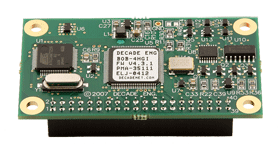
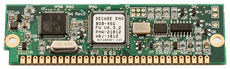
BOB-I vs. BOB-II
- BOB-I costs
more than double the price of BOB-II.
- BOB-I is much
larger and heavier than BOB-II, even allowing for the SIMM socket used with
BOB-II.
- BOB-II accepts
‘RS-232’ style asynchronous serial data at rates up to 19,200bps (in V1.2).
The data path to BOB-I is synchronous serial (separate clock &
data lines) at a much higher maximum rate—2.5Mbps. This implies that
faster screen updates are possible with BOB-I. If your host is fast enough,
BOB-I could rewrite all of its 240 characters in 1.6mS. BOB-II can rewrite
an entire screen of 308 characters in about 160mS (at 19.2kbps). If you’re
refreshing a moderate number of characters, either model is effectively "real-time."
- Application
programming is much simpler with BOB-II. From the programmer’s point of view,
it resembles a simple serial printer. BOB-I looks like a set of control registers
which must be managed at the individual bit level—it’s a typical ‘dumb peripheral’
device.
- BOB-I can adjust
its display position in single-pixel increments (the character display grid
moves en masse). BOB-II is restricted to movement in increments of
whole character cells.
- BOB-I offers
character size choices, including really HUGE characters. BOB-II has only
one size, and it’s smaller than BOB-I’s smallest size, yielding 308 displayable
characters for BOB-II versus 240 for BOB-I. BOB-II produces about the smallest
size of characters that may be superimposed on composite video with high legibility.
- BOB-I has a
chroma PLL, so it can produce color in Genlock/Overlay mode. BOB-II produces
only monochrome characters in this mode. Both models produce color in Local
video mode.
- BOB-II switches
video modes automatically, based on the presence of video input. BOB-I must
be controlled by the host, and the host may need an independent method of
detecting video presence.
- External character
& background brightness control is possible with BOB-II only.
- BOB-II is available
for NTSC video (USA) or PAL video (export). BOB-I is available for NTSC only.
- BOB-I has a
differential video input circuit to reject common-mode noise (often found
in industrial video systems), and a glitch-protected power input circuit.
BOB-II has a conventional video input circuit and basic power supply filtering.
Both models use on-board 5V regulator ICs, however.
- Variable character
transparency is easier to implement with BOB-II.
- Only BOB-II
offers an output from its video sync separator, which may be handy if auxiliary
video processing circuits are needed in your system.
- The character
sets are different. BOB-II has European language support and better symbols
for making horizontal and vertical bar graphs. BOB-I can make better lines
and frames.
Click BOB-I
or BOB-II for full product descriptions.
![[Dividing Line Image]](../images/horbar.jpg)
productsserviceslinksorderdealerssearchcontacthome